canon in d piano sheet music pdf

Canon in D Piano Sheet Music PDF: A Comprehensive Guide
Canon in D piano sheet music PDFs are widely available, offering various arrangements for different skill levels. Numerous websites provide free and paid options,
catering to beginner, intermediate, and advanced pianists. Explore resources like 8notes.com, MuseScore.com, and Cantorion for diverse interpretations.
Historical Context of Canon in D
Canon in D, originally composed by Johann Pachelbel around the 1680s, wasn’t immediately famous. It formed part of a larger suite titled Canon and Gigue in D major, a piece intended for three violins and basso continuo – a harmonic accompaniment often played by a cello or other bass instrument.

Its initial audience was relatively small, circulating amongst musicians in Germany during the Baroque period. The piece’s structure is remarkably simple yet elegant, built upon a repeating bassline – a ground bass – over which melodic variations unfold. This technique was common in Baroque music, but Pachelbel’s Canon stands out for its captivating harmonic progression and serene quality.
The work remained largely obscure for centuries, experiencing a significant revival in the 20th century. Its popularity surged, particularly in the latter half of the century, fueled by its use in popular culture, including weddings and film soundtracks. This resurgence led to numerous arrangements, including the now-ubiquitous piano adaptations, making the Canon in D accessible to a wider audience and solidifying its place as a beloved classical piece.
Johann Pachelbel: Composer Biography

Johann Pachelbel (1653-1706) was a German composer, organist, and teacher of the Baroque period. Born in Nuremberg, he received musical training from his father, a violinist, and later studied with renowned organists. Throughout his career, Pachelbel held various positions as a church organist and court musician, serving in cities like Stuttgart, Eisenach, and Nuremberg again.
While not as widely celebrated during his lifetime as contemporaries like Bach and Handel, Pachelbel was highly respected for his organ playing and compositional skills. He significantly contributed to the development of the chorale prelude and fugue, influencing subsequent generations of composers. His output included a substantial body of organ works, as well as sonatas, suites, and vocal pieces.
Interestingly, despite composing numerous works, Pachelbel is overwhelmingly known today for a single piece: the Canon in D. This enduring popularity, fueled by its beautiful melody and harmonic structure, has cemented his legacy, even if his other compositions remain less familiar to the general public. His work continues to inspire piano arrangements and sheet music adaptations.
The Original Canon in D: Orchestral Version
The original Canon in D, composed by Johann Pachelbel around the 1680s, wasn’t initially intended for the solo piano. It was written as part of a larger suite for three violins and basso continuo – typically a cello and harpsichord or organ. This orchestral version features a repeating bassline, over which the violins weave intricate melodic lines in a canon, meaning each violin imitates the previous one at a set interval.
The piece’s structure is remarkably simple yet profoundly effective. The repeating harmonic progression creates a sense of calm and serenity, while the interplay of the violin lines builds a rich and layered texture. It wasn’t widely known during Pachelbel’s lifetime, gaining significant popularity only in the 20th century.
The orchestral arrangement’s enduring appeal lies in its elegant simplicity and emotional resonance. This foundational version serves as the basis for countless adaptations, including the numerous piano sheet music PDFs available today, allowing pianists to explore and interpret Pachelbel’s masterpiece.
Adaptation for Piano: Why it’s Popular
The adaptation of Canon in D for solo piano has surged in popularity due to its accessibility and inherent beauty. While originally an orchestral piece, the piano arrangement allows individual musicians to perform this iconic melody without requiring an ensemble. The repeating harmonic structure translates beautifully to the piano’s capabilities, creating a lush and full sound even with a single instrument.
Furthermore, the availability of numerous piano sheet music PDFs, ranging from simplified beginner versions to complex arrangements by artists like Ben Dunnett, Lee Galloway, and Jacob Danao, caters to all skill levels. This inclusivity makes it a popular choice for students and amateur pianists.
Its frequent use in weddings and other ceremonies also fuels demand for piano arrangements. The calming and romantic nature of the piece, combined with the relative ease of learning a simplified version, makes it a staple in many pianists’ repertoires.
Availability of Canon in D Piano Sheet Music PDFs
Canon in D piano sheet music PDFs are remarkably accessible online, offering a wealth of options for musicians. Several websites specialize in free sheet music, notably 8notes.com and MuseScore.com, providing downloadable PDFs of varying arrangements. Cantorion also presents simplified versions geared towards beginner pianists, making the piece approachable for all levels.
Beyond free resources, numerous artists have created their own arrangements available as PDFs. Ben Dunnett’s arrangement, found via musictheoryacademy.com, is specifically designed for easy piano learning. Similarly, arrangements by Lee Galloway, Jim Paterson, Jacob Danao, and lemontart are readily available through various online platforms.
These PDFs often include options for transposition into different keys (F major, D major, etc.) and adjustments for printing, such as landscape or single-page views. Copyright information, typically around 2021-2025, is usually included with each arrangement.
Free Sheet Music Sources: 8notes.com
8notes.com stands as a prominent online resource for free Canon in D piano sheet music PDFs. The website offers a version specifically categorized under “Wedding Piano Sheet Music,” reflecting the piece’s popularity for ceremonial occasions. Users can readily download the score in PDF format, allowing for convenient access and printing.
A key feature of 8notes.com is its interactive tools. Musicians can transpose the sheet music to different keys – including F major, E major, and C major – to suit their preferences or vocal ranges. Tempo adjustments are also available, with a default setting around 100 BPM, though customization is encouraged;
The 8notes.com version, attributed to Johann Pachelbel, includes copyright information dating back to 2025-08-13. Options for landscape view and single-page printing are provided, enhancing readability and usability. Ben Dunnett is credited with contributions to the theoretical aspects of the arrangement, accessible through musictheoryacademy.com.
Free Sheet Music Sources: MuseScore.com
MuseScore.com provides a vast library of user-submitted sheet music, including numerous free Canon in D piano arrangements in PDF and MIDI formats. A notable offering is the arrangement of “Canon and Gigue in D major, P.37” by Johann Pachelbel, skillfully adapted for solo piano by lemontart.
The platform’s collaborative nature means multiple versions exist, catering to varying skill levels and stylistic preferences. Users can preview scores online before downloading, ensuring the arrangement aligns with their needs. The availability of MIDI files allows for playback and further manipulation within music software.
MuseScore.com’s arrangement, uploaded on 2025-09-24, benefits from community feedback and ratings, helping users identify high-quality transcriptions. The site’s search functionality allows filtering by instrument, composer, and arrangement type, streamlining the process of finding the perfect Canon in D sheet music. It’s a dynamic resource for pianists seeking free, accessible scores.
Free Sheet Music Sources: Cantorion
Cantorion offers several free Canon in D piano sheet music options, catering to different player abilities. They feature an “Easy Piano” arrangement of Johann Pachelbel’s famous work, specifically designed for beginner pianists. This abridged version simplifies the original composition, making it accessible for those new to the piece or piano playing in general.
Beyond the beginner-friendly version, Cantorion also provides arrangements by Lee Galloway, offering a different interpretation of the classic canon. These arrangements are downloadable in PDF format, allowing for easy printing and practice. The site’s interface is user-friendly, facilitating quick navigation and score access.
Cantorion’s offerings, with copyright dates ranging from 2015 to 2017, demonstrate a consistent commitment to providing free sheet music resources. The platform is a valuable resource for pianists seeking simplified or alternative arrangements of Canon in D, fostering musical exploration and enjoyment.
Sheet Music Arrangements by Ben Dunnett

Ben Dunnett provides a well-regarded arrangement of Canon in D for piano, available through 8notes.com and Music Theory Academy. His arrangement is specifically tailored for “Easy Piano,” making it an excellent choice for students and those seeking a less complex rendition of Pachelbel’s masterpiece. The score is presented in PDF format for convenient download and printing.
Dunnett’s work focuses on clarity and accessibility, simplifying the harmonic and melodic elements while retaining the essence of the original composition. He includes helpful markings like “mp Gently” to guide the performer’s interpretation. His arrangement is copyrighted 2021, reflecting a recent and updated version of the piece.
Furthermore, Music Theory Academy offers resources alongside the sheet music, potentially including theoretical insights and learning materials. This combination makes Dunnett’s arrangement not only a performance piece but also a valuable educational tool for aspiring pianists. His work is a popular choice for its balance of simplicity and musicality.
Sheet Music Arrangements by Lee Galloway
Lee Galloway’s arrangement of Canon in D for piano is readily accessible through Cantorion, a platform offering free sheet music. This version provides an alternative interpretation of Pachelbel’s iconic piece, catering to pianists seeking a different approach to the composition. The sheet music is available in PDF format, allowing for easy download and printing.
Galloway’s arrangement, like others, aims to translate the orchestral beauty of the original Canon in D to the piano. While details regarding the specific stylistic choices within the arrangement aren’t extensively detailed, its availability on Cantorion suggests a focus on accessibility for a broad range of players. The copyright date for this arrangement is listed as 2015-02-08.
Cantorion’s platform allows users to freely download and utilize Galloway’s arrangement, making it a valuable resource for pianists looking to expand their repertoire. It’s a convenient option for those seeking a readily available and cost-effective version of this beloved classical piece.
Sheet Music Arrangements by Jim Paterson
Jim Paterson offers a piano arrangement of Canon in D, discoverable through mfiles.co.uk. This arrangement, like others available online, seeks to adapt Pachelbel’s renowned composition for solo piano performance; The sheet music is presented in PDF format, facilitating easy access and printing for musicians.
The arrangement is noted with specific measure markings – 7, 11, 15, and 19 – potentially indicating key sections or structural points within Paterson’s interpretation. While detailed stylistic nuances aren’t explicitly outlined, the availability of the sheet music suggests a focus on providing a playable and recognizable rendition of the original piece.
Paterson’s arrangement provides pianists with another option for exploring Canon in D. It’s a valuable resource for those seeking alternative interpretations or arrangements suited to their skill level. The arrangement is presented as a simplified version, making it accessible to a wider audience of piano players.
Sheet Music Arrangements by Jacob Danao
Jacob Danao has created a piano arrangement of Canon in D, readily available as a PDF download. This arrangement, like many others circulating online, aims to translate Pachelbel’s orchestral masterpiece into a playable format for solo piano. The sheet music is designed for accessibility, offering pianists a chance to engage with this iconic piece.
Danao’s arrangement is identified by measure markings – 6, 11, 16, and 21 – which likely highlight significant musical phrases or structural components within the piece. These markings can serve as helpful guides for performers navigating the arrangement. The availability of this PDF allows for convenient practice and performance.
This arrangement provides another avenue for pianists to explore Canon in D. It’s a valuable resource for those seeking a specific interpretation or a version tailored to their playing ability. Danao’s work contributes to the diverse landscape of piano arrangements available for this beloved composition.
Sheet Music Arrangements by lemontart
lemontart offers a piano arrangement of Johann Pachelbel’s Canon in D, accessible as a free PDF download through platforms like MuseScore.com. This arrangement, designed for solo piano, provides an opportunity for pianists to interpret the famous canon in a more intimate setting. It’s a popular choice for those seeking a readily available and relatively accessible version of the piece.
The arrangement by lemontart, identified with a timestamp of 2025-09-24T14:43:48, suggests ongoing availability and potential updates to the sheet music. This version likely caters to a range of skill levels, offering a simplified yet recognizable rendition of the original orchestral work.
lemontart’s contribution expands the options available to pianists wanting to learn and perform Canon in D. The PDF format ensures easy access and printing, making it a convenient resource for practice and performance. It’s a testament to the enduring popularity of this timeless composition and the dedication of arrangers like lemontart.
Difficulty Levels: Beginner, Intermediate, Advanced
Canon in D piano sheet music PDFs are available across a spectrum of difficulty levels, catering to pianists of all abilities. Beginner arrangements, like those found on Cantorion, often present an abridged version, simplifying the harmonic and melodic complexities of the original. These versions prioritize accessibility, focusing on core melodic lines and basic chord progressions.
Intermediate arrangements maintain more of the original harmonic richness while still being manageable for players with some experience. Arrangements by Ben Dunnett and Lee Galloway likely fall into this category, offering a balance between authenticity and playability.
Advanced pianists can explore more complex arrangements that faithfully reproduce the original’s intricate counterpoint and harmonic depth. These versions demand a strong technical foundation and a nuanced understanding of musical interpretation. The availability of varied difficulty levels ensures that Canon in D remains accessible and rewarding for pianists at every stage of their musical journey.
Understanding Sheet Music Notation for Piano
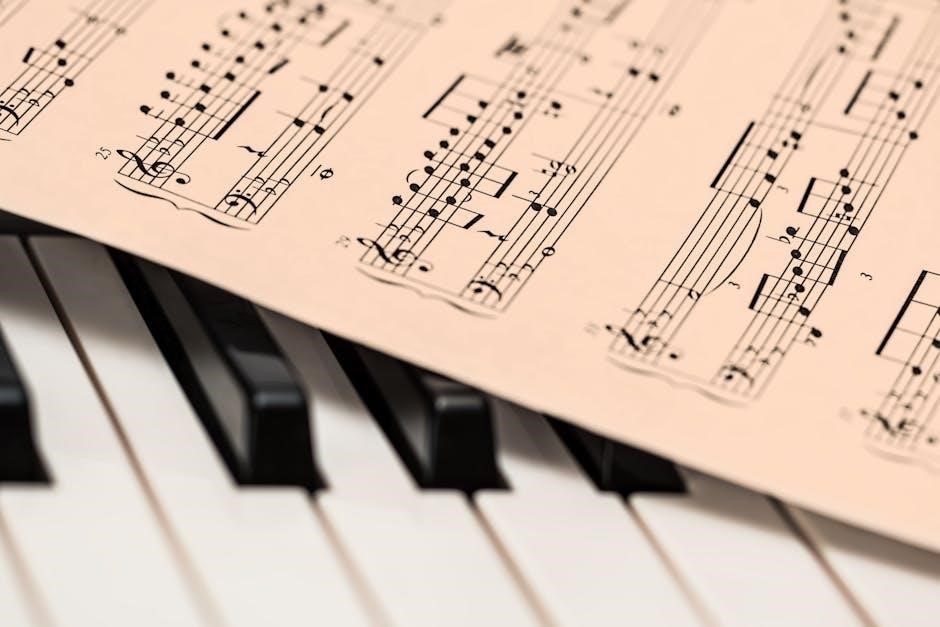
Successfully navigating Canon in D piano sheet music PDFs requires a grasp of fundamental music notation. The grand staff, comprised of treble and bass clefs, displays the melody and harmony. Note values – whole, half, quarter, and eighth notes – dictate rhythm, while rests indicate silence. Understanding time signatures (typically 4/4 in Canon in D) is crucial for maintaining a consistent tempo.
Sharps (#) and flats (♭) alter pitches, and key signatures indicate frequently occurring sharps or flats. Dynamics markings (p for piano, f for forte) guide expressive playing. Pay attention to slurs and ties, which connect notes, and repeat signs to efficiently navigate the piece.
Familiarity with chord symbols (e.g., D, G, A) aids in understanding the harmonic progression. Recognizing these elements unlocks the beauty and structure of Pachelbel’s masterpiece, allowing pianists to interpret the music with confidence and artistry.
Key Signatures and Transposition Options (F Major, D Major, etc.)
Canon in D is originally written in the key of D major, featuring no sharps or flats in its key signature. However, many piano sheet music PDF arrangements offer transposition options to suit different vocal ranges or instrumental preferences. Common transpositions include F major, which introduces one flat (B♭), and other related keys like A major or G major.
Transposing alters the overall pitch of the piece while preserving its harmonic structure. Pianists can utilize transposition features within music notation software or manually adjust the notes. Understanding key signatures is vital for accurately reading transposed sheet music.
While D major is the original and most frequently encountered key, exploring alternative keys can offer a fresh perspective on this timeless composition. Remember to adjust any accidentals accordingly when transposing to maintain the correct musical intervals.
Tempo Considerations (Typically around 100 BPM)
Canon in D is traditionally performed at a moderate tempo, generally around 100 beats per minute (BPM). However, interpretations can vary, and sheet music PDFs may not always specify a precise tempo marking. Many arrangements suggest a tempo range, allowing pianists to express their artistic interpretation.
A tempo of 100 BPM provides a balance between clarity and flow, enabling the intricate melodic lines to be distinctly heard. Faster tempos can create a more energetic feel, while slower tempos emphasize the piece’s lyrical quality. When using sheet music PDFs, consider the arrangement’s style and intended mood when selecting a tempo.
Utilizing a metronome during practice is highly recommended to maintain a consistent tempo. Experimenting with slight tempo variations can add nuance to your performance, but always prioritize rhythmic accuracy and musicality.
Copyright Information and Usage Rights (2021, 2025)
Canon in D, originally composed by Johann Pachelbel, is in the public domain. However, specific piano arrangements and transcriptions found as PDF sheet music are often subject to copyright. Arrangements by individuals like Ben Dunnett (©2021, musictheoryacademy.com) and lemontart (as noted on MuseScore.com with a timestamp of 2025-09-24) retain copyright protection.
When downloading and using sheet music PDFs, it’s crucial to respect these copyrights. Free sheet music sources generally permit personal, non-commercial use, such as practicing and private performance. Distribution, modification, or performance for profit typically requires permission from the copyright holder.
Pay attention to any licensing information provided with the PDF. Some arrangements may have Creative Commons licenses allowing certain types of reuse with attribution. Copyright dates, like those from 2021 and 2025, indicate the year the specific arrangement was created and protected.

Printing and Formatting Options (Landscape, Single Page)
When downloading Canon in D piano sheet music PDFs, consider printing options for optimal readability. Many sources, like 8notes.com, offer formatting choices before downloading. A common preference is selecting “Landscape” orientation, especially for arrangements spanning multiple pages, to minimize page turns during playing.
The “Single Page View” option is also frequently available, consolidating multiple systems onto one page – useful for experienced readers, but potentially cramped for beginners. PDF viewers allow further customization; adjusting margins and scaling can improve clarity. Ensure your printer settings match the paper size specified (typically A4 or Letter).
Previewing the PDF before printing is highly recommended to verify the layout and ensure all musical information is visible. Some arrangements may benefit from printing in grayscale to save ink. Experiment with different settings to find what works best for your reading style and printer capabilities, enhancing your learning experience.
Looking for beautiful Canon in D piano sheet music? Get your free, high-quality PDF download here! Perfect for all skill levels – start playing today! ✨