cell cycle and mitosis worksheet answer key pdf

Cell Cycle and Mitosis Worksheet Answer Key: An Overview
Honors Biology exercises focusing on cell biology, readily available on platforms like Docsity, Course Hero, and Studocu, provide comprehensive
answers. These resources detail mitosis phases, diagram identification, and cell structure labeling, aiding in understanding the cell cycle.
Understanding the Core Concepts
Mitosis, a fundamental process in cell division, is thoroughly explored in worksheet answer keys found on educational platforms. These resources emphasize recognizing phases like prophase, metaphase, anaphase, and telophase through diagram identification.
Understanding the cell cycle – encompassing interphase (G1, S, and G2 phases) and the mitotic phase – is crucial. Worksheets often require students to label cell structures and match terms to descriptions, solidifying comprehension. Answer keys from Docsity, Course Hero, and Studocu provide detailed explanations of events occurring in each phase, including DNA replication during the S phase and growth during G1 and G2. Mastering these concepts is essential for grasping the intricacies of cellular reproduction.
The Cell Cycle: A Detailed Breakdown
Worksheets dissect the cell cycle into interphase (G1, S, G2) and the mitotic phase, offering answer keys for comprehensive understanding.
Interphase: Preparation for Division
Interphase, the longest phase of the cell cycle, is crucial for growth and DNA replication, preparing the cell for division. Worksheets emphasize that it’s divided into G1, S, and G2 phases. During G1, the cell grows and functions normally, passing a checkpoint to ensure readiness. The S phase is dedicated to DNA replication, creating identical sister chromatids.

Following replication, the G2 phase involves further growth and final preparations for mitosis, including another checkpoint verifying DNA integrity. Answer keys on Docsity, Course Hero, and Studocu highlight that Interphase isn’t part of mitosis itself, but a vital preparatory stage. Understanding these phases is key to correctly identifying stages on cell cycle diagrams found in biology exercises.
G1 Phase: Growth and Normal Function
The G1 phase, the first growth phase, is a period of intense cellular activity and preparation. Worksheet answer keys detail that cells increase in size, synthesize new proteins and organelles, and carry out their normal functions during this stage. A critical G1 checkpoint assesses cell size, growth factors, and the surrounding environment to determine if conditions are suitable for DNA replication.
If the checkpoint is passed, the cell proceeds to the S phase; otherwise, it may enter a resting state. Biology resources on platforms like Docsity and Course Hero emphasize that successful completion of G1 is essential for accurate DNA replication. Diagram identification exercises often require students to recognize that G1 represents a period of active growth, not visible changes in the nucleus.
S Phase: DNA Replication
The S phase is critically defined by DNA replication, a process meticulously detailed in mitosis worksheet answer keys. During this phase, each chromosome is duplicated, resulting in two identical sister chromatids connected at the centromere. Biology resources, such as those found on Studocu and Course Hero, highlight the importance of accurate replication to ensure genetic continuity.
Worksheets often include questions about the outcome of the S phase – a doubling of genetic material. Diagram identification tasks require students to recognize the replicated chromosomes. While no visible changes occur in the nucleus during the S phase, it’s a period of intense molecular activity, preparing the cell for subsequent phases of the cell cycle and eventual division.
G2 Phase: Further Growth and Preparation
The G2 phase represents the final stage of preparation before mitosis, as detailed in mitosis worksheet answer keys available on platforms like Docsity. This phase involves continued cell growth and the synthesis of proteins and organelles necessary for cell division. Biology resources emphasize that the cell verifies the successful completion of DNA replication during the S phase, ensuring no errors persist.
Worksheets frequently assess understanding of the G2 checkpoint, a critical control point ensuring the cell is ready to proceed. Questions often focus on the production of microtubules and other components of the spindle fibers. Successful completion of the G2 phase commits the cell to mitosis, initiating the dramatic events of nuclear and cell division.

Mitosis: The Process of Cell Division
Mitosis, explored in worksheet answer keys on Docsity and Course Hero, is a fundamental process involving distinct phases: prophase, metaphase, anaphase, and telophase.
Prophase: Chromosome Condensation
Prophase, detailed in mitosis worksheet answer keys found on resources like Studocu and Course Hero, marks the initial stage of mitosis. During this crucial phase, chromosome condensation occurs, transforming the loosely packed chromatin into visible, distinct structures. The nuclear envelope begins to break down, dismantling its protective barrier around the genetic material.
Simultaneously, the spindle fibers start to form, emanating from structures called centrioles (in animal cells). These fibers will eventually play a vital role in separating the chromosomes. Key worksheet questions often focus on identifying prophase in cell diagrams, recognizing the condensed chromosomes and the disappearing nuclear envelope. Understanding these events is fundamental to grasping the entire mitosis process, as outlined in Honors Biology exercises.
Metaphase: Chromosome Alignment
Metaphase, a critical stage detailed in mitosis worksheet answer keys available on platforms like Docsity and Course Hero, is characterized by precise chromosome alignment. The condensed chromosomes, each consisting of two identical sister chromatids, migrate to the metaphase plate – an imaginary plane in the middle of the cell.
This alignment is orchestrated by the spindle fibers, which attach to the centromeres of the chromosomes. Worksheet exercises frequently ask students to identify metaphase cells based on this characteristic arrangement. Correct alignment ensures that each daughter cell receives a complete and identical set of chromosomes. Understanding metaphase is crucial, as it sets the stage for the subsequent separation of sister chromatids in anaphase, as covered in Honors Biology materials.
Anaphase: Sister Chromatid Separation
Anaphase, frequently assessed on cell cycle and mitosis worksheets found on resources like Studocu and Course Hero, marks the separation of sister chromatids. The centromeres divide, and the now-individual chromosomes are pulled towards opposite poles of the cell by the shortening spindle fibers.
Worksheet diagrams often require students to identify anaphase cells by the distinct V-shape formed as chromosomes move apart. This phase ensures each daughter cell receives a complete set of genetic information. Honors Biology materials emphasize that anaphase is a highly regulated process, and errors can lead to aneuploidy. Correct identification of anaphase is vital for understanding the mechanics of cell division and its implications for genetic stability, as detailed in mitosis worksheet answer keys.
Telophase: Nuclear Envelope Reformation
Telophase, a key stage frequently featured in cell cycle and mitosis worksheet materials available on platforms like Docsity and Course Hero, signifies the final stage of nuclear division. During telophase, the chromosomes arrive at the poles and begin to decondense, returning to their less compact form.
Simultaneously, the nuclear envelope reforms around each set of chromosomes, creating two distinct nuclei. Spindle fibers disappear, and the cell prepares for cytokinesis. Worksheet questions often ask students to differentiate telophase from other phases by identifying the presence of reforming nuclei. Understanding telophase is crucial for grasping the complete process of mitosis, as highlighted in mitosis worksheet answer keys, and its role in producing genetically identical daughter cells.
Key Structures in Mitosis
Mitosis relies on chromosomes, spindle fibers, and the centromere, structures frequently labeled on cell cycle worksheets found on Studocu and Docsity.
Chromosomes and Chromatids
Chromosomes, visible during mitosis, contain DNA and are crucial for genetic inheritance. Worksheets often require identifying them in cell diagrams, available on Course Hero. Before division, each chromosome replicates, forming identical sister chromatids connected at the centromere.
Understanding the difference between a single chromosome and duplicated chromatids is key. Answer keys on Docsity emphasize this distinction. During anaphase, these chromatids separate, ensuring each daughter cell receives a complete set of genetic information. Diagrams frequently illustrate this separation, testing comprehension of chromosome structure and behavior throughout the cell cycle. Correctly labeling these structures on mitosis worksheets demonstrates understanding.
Spindle Fibers and Centrioles
Spindle fibers, composed of microtubules, are essential for chromosome movement during mitosis. Centrioles, found in animal cells, organize these fibers, forming the mitotic spindle. Worksheets, like those found on Studocu, often ask students to identify these structures in cell diagrams.
Spindle fibers attach to chromosomes at the centromere, pulling sister chromatids apart during anaphase. Answer keys on Docsity highlight this process. While centrioles aren’t present in plant cells, a spindle still forms. Understanding the function of spindle fibers is crucial for grasping mitosis. Correctly labeling these components on mitosis worksheets demonstrates comprehension of their roles in cell division and the overall cell cycle.
Centromere: The Connection Point
The centromere is a specialized region on a chromosome that links sister chromatids together during early mitosis. Worksheets, available on platforms like Course Hero, frequently require students to identify the centromere in cell diagrams. It serves as the attachment point for spindle fibers, crucial for accurate chromosome segregation.
During anaphase, the centromere divides, allowing sister chromatids to separate and move towards opposite poles of the cell. Answer keys on Docsity emphasize this critical event. Understanding the centromere’s function is vital for comprehending how genetic material is faithfully distributed during cell division. Correctly identifying it on mitosis worksheets demonstrates understanding of its role in the cell cycle.
Worksheet Components & Common Questions
Mitosis worksheets commonly include diagram identification, cell structure labeling, and term matching (Prophase, Interphase). Answer keys aid comprehension.
Diagram Identification: Phases of Mitosis
Diagram identification is a core component of mitosis worksheets, requiring students to accurately recognize phases like Prophase, Metaphase, Anaphase, and Telophase. Worksheets often present cells in various stages, challenging students to visually distinguish characteristics. For example, identifying Prophase involves recognizing chromosome condensation, while Metaphase demands spotting aligned chromosomes.
Course Hero and Docsity provide answer keys with labeled diagrams for comparison. Students must analyze cellular structures – spindle fibers, centrioles, and the nuclear envelope – to determine the phase. A common question asks students to order phases correctly. Successfully identifying phases demonstrates understanding of the dynamic processes occurring during cell division, and reinforces the sequential nature of mitosis.
Labeling Cell Structures
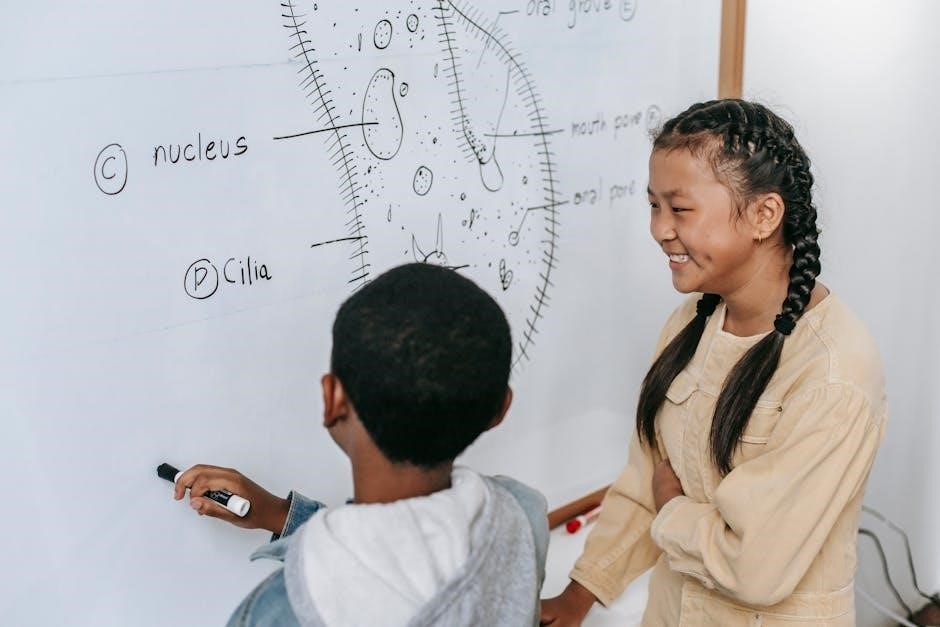
Labeling cell structures on diagrams is crucial for mastering mitosis. Worksheets commonly require identifying components like chromosomes, sister chromatids, the centromere – the connection point – spindle fibers, and centrioles. Accurate labeling demonstrates comprehension of each structure’s role in cell division.
Answer keys available on platforms like Docsity and Studocu provide reference diagrams. Students must differentiate between structures present in different phases; for instance, recognizing the forming nuclear envelope in Telophase. Understanding the function of each labeled part – how spindle fibers attach to centromeres, for example – is key. This exercise solidifies knowledge of the physical mechanisms driving mitosis and the cell cycle.
Matching Terms to Descriptions (Prophase, Interphase, etc.)
Mitosis worksheet answer keys frequently include a matching section, testing understanding of phase-specific events. Students must correctly associate terms like Prophase, Interphase, Metaphase, Anaphase, and Telophase with their corresponding descriptions. For example, matching Interphase with “growth and replication of DNA”.
Resources on Course Hero and Studocu provide example matching exercises and solutions. Correctly identifying that Prophase involves chromosome condensation, or Metaphase signifies chromosome alignment, demonstrates a firm grasp of the cell cycle. This tests not just memorization, but the ability to connect terminology with the actual biological processes occurring during each stage of mitosis.
Answer Key Focus Areas
Answer keys prioritize phase identification from cell diagrams, accurate event descriptions within each stage, and comprehension of crucial cell cycle checkpoints.
Identifying Phases from Cell Diagrams
Accurately identifying phases – Interphase, Prophase, Metaphase, Anaphase, and Telophase – is fundamental. Worksheet answer keys emphasize recognizing chromosome condensation in Prophase, their alignment during Metaphase, and sister chromatid separation in Anaphase.
Diagrams often depict cells at varying stages; students must discern these based on visual cues. For example, a cell with a clearly defined nuclear envelope and visible chromatin indicates Interphase. Conversely, a cell with condensed chromosomes and a disappearing nuclear envelope signifies Prophase.
Key resources like Docsity and Course Hero provide labeled diagrams for comparison. Mastering this skill requires careful observation and understanding of the defining characteristics of each mitosis phase, ensuring correct phase identification on the worksheet.
Describing Events in Each Phase
Worksheet answer keys require detailed descriptions of events within each mitosis phase. During Prophase, chromosomes condense and become visible, while the nuclear envelope breaks down. Metaphase involves chromosome alignment at the cell’s equator, facilitated by spindle fibers.
Anaphase is characterized by the separation of sister chromatids, pulled towards opposite poles. Finally, Telophase witnesses the reformation of nuclear envelopes around the separated chromosomes. Interphase, though not technically mitosis, involves growth and DNA replication.
Resources like Studocu and Course Hero offer comprehensive explanations. Students must articulate these events precisely, demonstrating understanding of the sequential processes driving cell division. Accurate descriptions are crucial for achieving a complete and correct worksheet response.
Understanding Checkpoints in the Cell Cycle
Cell cycle checkpoints are critical control mechanisms ensuring accurate DNA replication and cell division. The G1 checkpoint assesses cell size, growth, and the environment before committing to DNA replication. A key focus of worksheet questions involves identifying the purpose of these regulatory points.
The G2 checkpoint verifies DNA replication completion and checks for any damage before entering mitosis. During metaphase, the spindle assembly checkpoint confirms proper chromosome attachment to spindle fibers.
Answer keys emphasize understanding how these checkpoints prevent errors and maintain genomic stability. Docsity and Course Hero provide detailed explanations. Failure at these checkpoints can lead to uncontrolled cell division and potential cancer development.
Resources for Further Study
Online biology resources like Docsity, Course Hero, and Studocu offer detailed cell cycle and mitosis explanations, plus worksheet solutions.
Online Biology Resources (Docsity, Course Hero, Studocu)
Docsity, Course Hero, and Studocu are invaluable platforms for students seeking assistance with cell cycle and mitosis concepts. These websites host a wealth of materials, including completed worksheets, detailed explanations, and illustrative diagrams. Specifically, you can find Mitosis Worksheet Answer Keys, often submitted by fellow students who have already tackled similar assignments.
Course Hero provides access to Honors Biology exercises and cell biology resources, while Studocu offers Cell Cycle Worksheets with answers, clarifying the mitosis process. These platforms allow you to compare different approaches to problem-solving and gain a deeper understanding of the material. Searching for “Mitosis Worksheet KEY.pdf” will yield relevant documents. Remember to utilize these resources responsibly, focusing on understanding the concepts rather than simply copying answers.
Stuck on your cell cycle & mitosis worksheet? Find clear, easy-to-understand answers & explanations here! Boost your grade with our PDF guide. Let’s learn!